
Sustainability: boosting the impact of TV advertising in various ways
Sustainability is important to people in Switzerland when it comes to consumption (see Admeira study ‘Relevanz der Nachhaltigkeit’ [Relevance of Sustainability]). This means that, among other things, sustainability is becoming increasingly important for advertisers, which is why Admeira is also dedicated to this topic in its advertising impact research. The experimental study ‘ECOntent’ investigated whether the benefits of sustainable products combined with communicative elements on sustainability can bring direct impact benefits for advertisers. In addition, the question of what impact a sustainable advertising environment has was explored.
Research design: advertising impact in three different experimental groups
The experimental study ‘ECOntent’, carried out in collaboration with research partner Create XY and field partner GfK, focuses on the impact of sustainability in relation to the product, advertising content and media content. Specifically, the impact of the creative elements of TV commercial production and placement in different environments were investigated.
For the experimental study, 289 subjects were divided into three groups of approximately equal size with similar demographic structure (age/gender). A fictional sunscreen with the name ‘Nusolar’ was advertised to all groups through a TV commercial. It is important to mention that this product was not known by any of the subjects, so there were no existing effects of the Nusolar brand.
Experimental group 1: neutral commercial in a neutral environment
For Group 1, Nusolar sunscreen was advertised without a focus on sustainability. This neutral commercial was placed in a neutral TV environment (documentary ‘Tattoo - für immer und fast ewig’).
Video 1: commercial for the Nusolar product presented in a neutral (NEUT) environment, without a focus on sustainability.
Nusolar as an ‘ordinary’ sunscreen that promises high UV protection, is suitable for all skin types and is now available in retail stores.
Experimental group 2: sustainable commercial in a neutral environment
In group 2, the Nusolar product was advertised with a focus on sustainability. This eco-commercial was placed in the same neutral TV environment as in group 1 (documentary ‘Tattoo - für immer und fast ewig’).
Video 2: advertisement of the product Nusolar in an ecological (ECO) environment, with a focus on sustainability.
Nusolar positioned as a sunscreen that’s sustainably produced in Switzerland. In addition to the high UV protection, reference is also made to natural plant oils from organic farming. This results in the product promising both ‘holidays without a worry’ and a clear conscience.
Experimental group 3: sustainable commercial in a sustainable environment
As in group 2, the Nusolar product was advertised to group 3 with references to the sustainability of the product. Here, however, the eco-commercial was placed in an SRF environment with a focus on sustainability (nature documentation on animals behind the camera).
The TV commercials were embedded in a 10-minute snippet of a TV programme. Even this short time in the environment of a programme with a focus on sustainability is enough to have a positive effect on the brand image of the Nusolar brand.
Impact of the advertising environment
The differences are striking between the advertising impact of these three experimental groups, each of which only saw the commercial once (TV commercial length: 26 seconds) . The sustainable product creation and communication with reference to sustainability in the TV commercial have multiple direct benefits when it comes to impact.
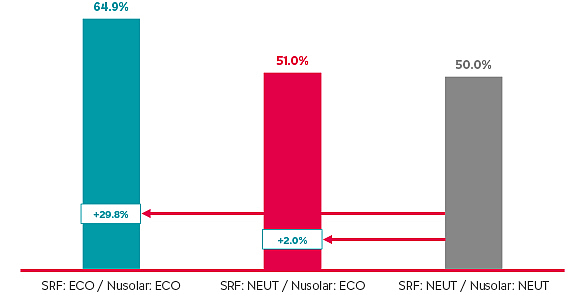
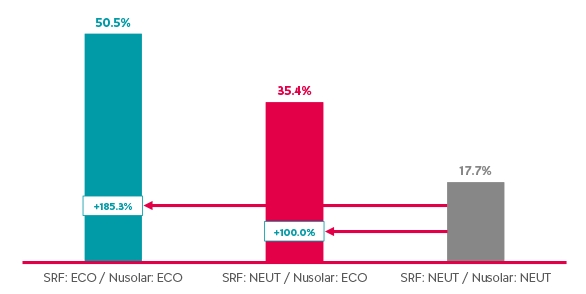
For example, in group 3, which saw the sustainable TV commercial in an environment with a focus on sustainability, brand sympathy is significantly higher at 65% than in the other two experimental groups (see Fig. 1). The brand’s value, being that Nusolar stands for sustainability, can also be greatly increased by placing it in a sustainable broadcasting environment (see Fig. 2). In addition to an increase of 17 percentage points due to a commercial aimed at sustainability, a further increase of 15 percentage points is possible here thanks to the sustainable broadcasting environment (theme of animals instead of the theme of tattoos).
Contribution to impact of the commercial with a focus on sustainability
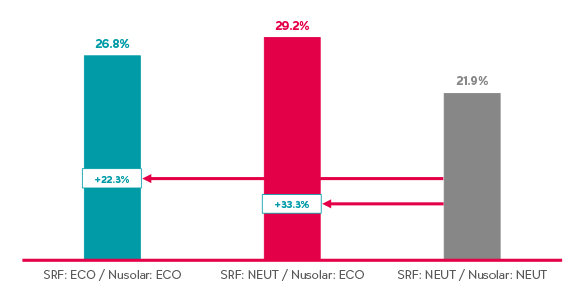
With the commercial that has a focus on sustainability (Video 2), general recall effects, i.e. a free advertising reminder, can also be achieved. 27% to 29% of the subjects remember the Nusolar brand after contact with the sustainable TV commercial. In the case of the TV commercial that did not have a focus on sustainability, only 22% of the subjects freely recall the brand (see Fig. 3).
Awareness is the basis for all other success factors in the sales funnel: brand image, consideration, preference and purchase intent. On all these queried KPIs, commercial version 2 performs better with it’s focus on sustainability.
What is interesting is that the sustainable commercial variant is sometimes even slightly better activated in a neutral broadcasting environment (in awareness, preference and purchase intent) than in a broadcasting environment with a focus on sustainability. This can possibly be explained by the psychological phenomenon of salience. Salience means that a stimulus (in this case, the TV commercial) stands out from its context (in this case, the broadcasting environment) and is thus more easily accessible to the consciousness than a non-salient stimulus.
Conclusion
In the TV market, advertising prices are determined by audience measurement/media measurement. There is a lot of talk about GRPs, ranges and OTS as well as the new challenges in media measurement. As a result, the issue of advertising impact is sometimes not given the attention it deserves. This is despite the fact that advertising views per se should not be the aim of a successful campaign. More important is the impact benefit (effect on the brand and sales) resulting from views. This study shows that an advertising view (with the same length, the same coverage and the same screen) has a different advertising impact depending on the setting (environment, creation).
Focusing on advertising impact factors in the context of sustainability is therefore worthwhile. The sustainable staging of a sustainable product brings benefits in all success factors. While placing a sustainable product in a sustainable broadcasting environment has a very positive impact on brand image, placing the sustainable product in a neutral environment brings benefits for awareness and activation. Advertising creation and advertising placement are thus demonstrably decisive levers for an effective advertising campaign alongside GRPs and CPUs.
Study overview
Topic
Study on the impact of sustainability in TV commercial creation and the TV environment
Method
On-line experiment with subsequent questionnaire
Universe
Population of German-speaking Switzerland and French-speaking Switzerland, 15–74 years old and in the online community of users
Area
German-speaking Switzerland
Sample
289 subjects divided into three structure-like experimental groups (monads)
Institute conducting the research
Create XY, Zurich and GfK Switzerland AG, Rotkreuz
More information and answers directly from: