
Study on the relevance of TV among advertising channels in Switzerland: TV is the flagship for advertising perception
In a representative study for Switzerland, around 1,000 consumers were surveyed about the characteristics of different advertising vehicles. It found that, of all advertising channels, TV advertising works the best. As a result, brands that really want to be seen should focus on TV, from a B2C perspective.
TV is the top advertising channel for advertising perception
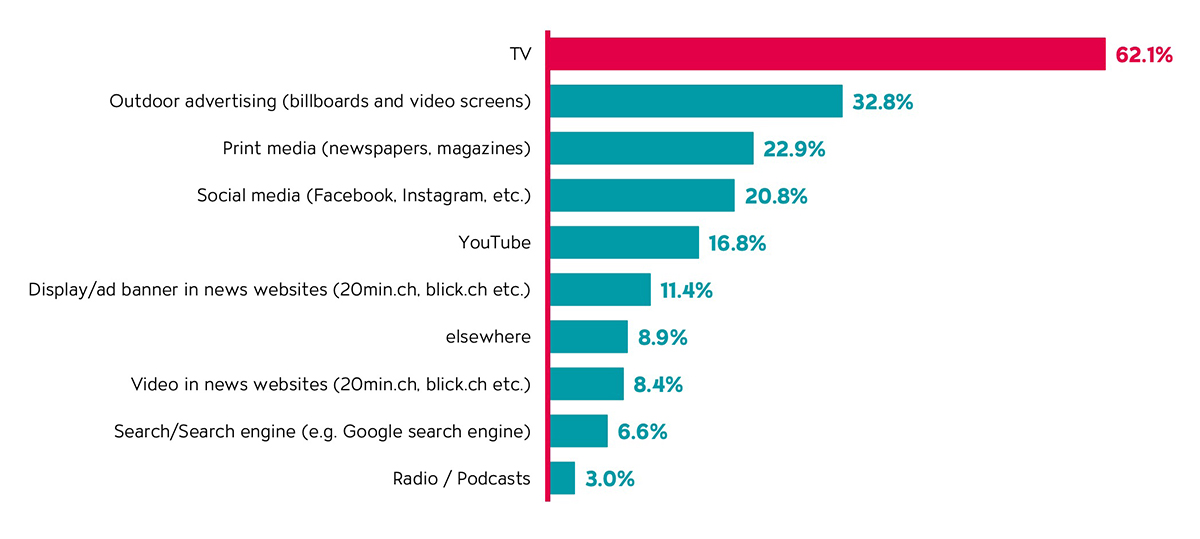
Respondents (n=1,002) were asked to name a brand with an advertisement they can remember particularly well. They listed 248 different brands, with. the most frequently cited brand racking up 100 mentions.
When they were then asked where they saw the advertisement they recalled, it became clear that brands are able to reach their consumers on different advertising channels. TV advertising, however, is the most noticed and the best remembered. Around 62% of respondents saw the brand whose advertisement they remembered on TV.
Out-of-home advertising (posters and video screens) is the second most popular ‘reach medium’ by a considerable margin, at 33%. The first direct competitor to TV in the moving-image sector only manages to make fourth place, while 21% of respondents also attributed the advertisement they recalled to social media.
Subsequent psychological effects of advertising perception
Of course, recollections of adverts need to be treated with further nuance: not every perception is of the same quality. There is an expectation that contact with advertising will trigger psychological processes in recipients that are beneficial to the brand being advertised.
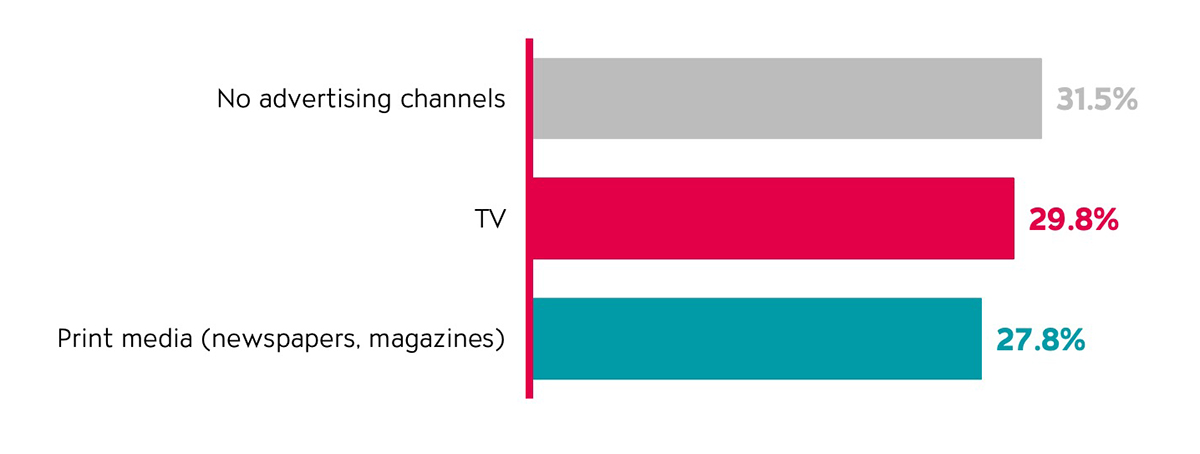
The study examined two psychological effects of advertising (‘influence on purchasing decision’ and ‘credibility of advertising’), across all media channels. Two media channels stand out, in particular: TV and print media. These two advertising channels performed best in terms of the two psychological effects studied.
For ‘influence on purchasing decision’, it should be noted that a relative majority say they make their purchasing decision independently of advertising. Hot on the heels of these statements, however, TV and print rank as the strongest advertising channels for influencing purchases. Social media also performed well, being mentioned by 27% of respondents (position 4).
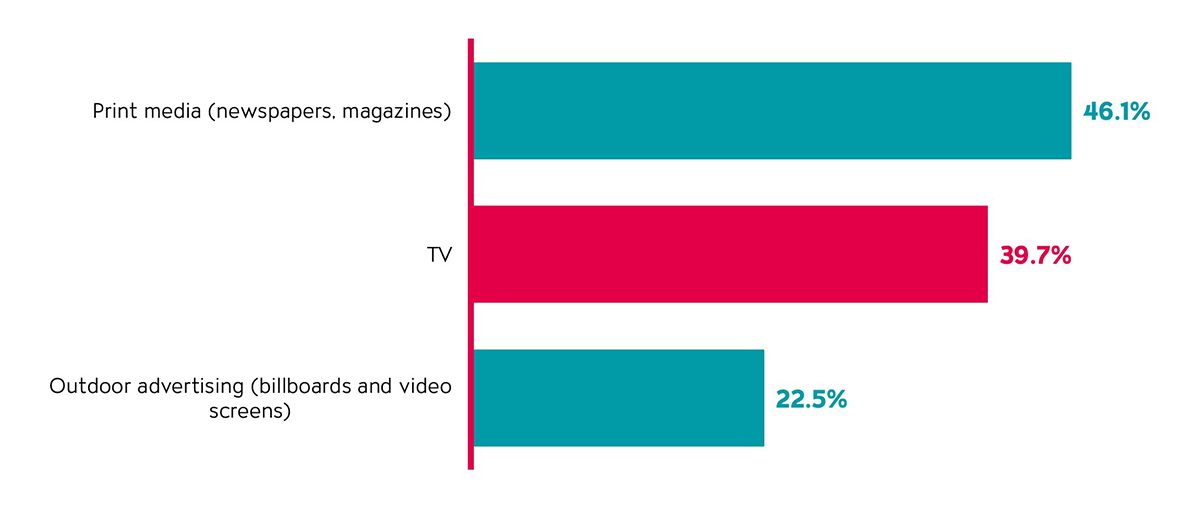
In terms of the ‘credibility of advertising’, print media ranked as the best advertising medium. The number one moving-image channel is TV, which was listed by around 40% of respondents (see also the Swiss Screenforce Study 2022 on this topic). Out-of-home advertising also made it into the top three in terms of credibility, being cited by 23% of respondents.
TV meets the needs of consumers and advertisers
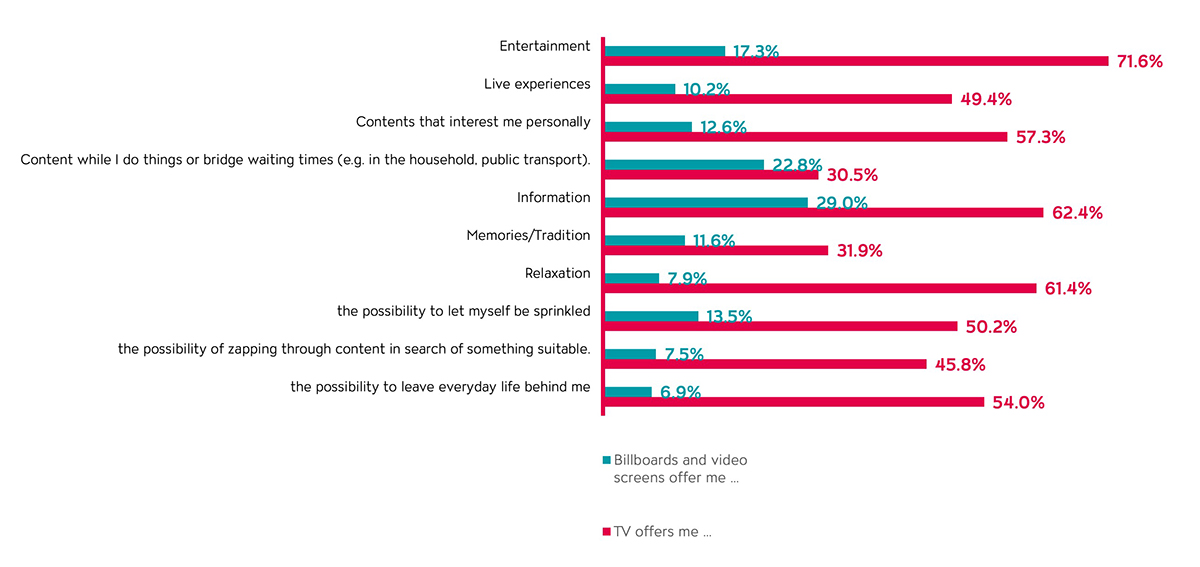
Given the qualities highlighted, it is no surprise that consumers refer to TV as their favourite advertising channel – ahead of print media and ‘no advertising channel’. In addition to all the advantages that TV offers advertisers as an advertising channel, viewers also value TV as a media channel.
No other medium meets the consumer needs shown in Figure 4 better than TV, overall (definition of need groups taken from the Screenforce study ‘Mapping the Moods’). The comparison with outdoor advertising is particularly striking: posters and video screens are scarcely able to satisfy a media need.
Summary
In terms of both perception and sales, TV proved itself to be a thoroughly convincing advertising channel. When it comes to investments in advertising, money is best spent where consumers like advertising the most: on their favourite advertising channel – TV.
Discover more findings from impact studies in our video:
Study profile
Topic
Study on the characteristics of advertising vehicles (consumer perspective 2022)
Method
Online survey using EFS Survey software from Tivian
Data source
intervista online panel
Area
German-speaking and French-speaking Switzerland
Target group
15- to 74-year-olds
Quotas and weighting
Interlocking quotas by gender x age (15–29, 30–44, 45–59, 60–74) x language region, according to current, population-representative guidelines from the Federal Statistical Office (FSO). Weighting is used to compensate for small deviations from the target distribution.
Sample size
n = 1,002 (749 from German-speaking Switzerland, 253 from French-speaking Switzerland)
More information and answers directly from: